
Even though we often think that our planet is already explored, but there is many more to be discovered. Very often some new unexplored creatures show up. These are the newest animal species that almost nobody knew they existed!
1. Masked Frog ( Noblella Madreselva )
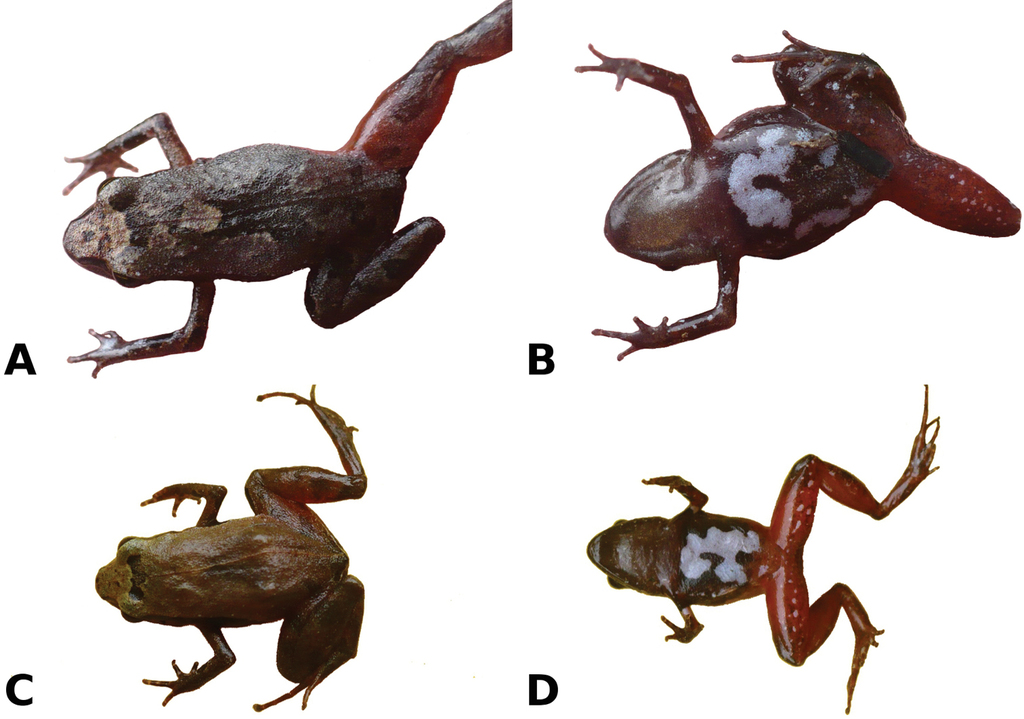
Image by: zookeys.pensoft.net
Discovered in Peru, this tiny frog can fit on the tip of a human finger. It has been found in 2350 metres high in the Andes. They're active during the day, and live in leaf litter on the forest floor. Those ( Brachycephalus ) frogs, came in colors ranging from greenish-brown to bright orange and blue. By having a broad, white mark on black background on chest and belly, irregularly shaped, this frog species is much different from all other Nobellia species. Noblella madreselva is a really tiny frog, approximately 15-18 mm in length.
This frog species is very vulnerable to the effects of deforestation and habitat loss, because of its limited geographical range. But because almost all amphibian species are endangered today, so it is not uncommon that his frogs population also is devastated.
2. Acrobatic Spider (Cebrennus Rechenbergi )

The spider hides from predators in its own sandcastles, towers made of sand and silk that give it protection from a the desert sun. Found in Morocco, is a very agile spider flee from predators with waterfalls. For any signs of danger threatening attitude adopted first, but if that strategy does not work, shopping and falls to accelerate their flight. Since you live in the desert where there is no place to hide, the researchers believe that this strategy is the latest trick to do to escape predators. His behavior inspired the creation of a robot that copies the way they move.
It propel itself off the ground and initiate “flic-flac” jumps that allow it to move uphill and on a flat surface. And because of that the spider can move twice as fast as if it were walking.
3. The Walking Stick Bug ( Phryganistria Tamdaoensis )

The walking sticks are among the largest insect species of the world. Their big size is no treat because these insects are gentle; they perch quietly in trees, eating leaves and blending in with the background. That 23 cm long stick insect species was found in Vietnam. When disturbed, giant sticks are slow-moving and drop motionless to the ground. Science’s slowness to find these giant insects is compelling evidence that more remains to be discovered. With its size of 9 inches, Phryganistria tamdaoensis is not be the world’s longest stick, but it comes to second place right after Phobaeticus chani.
Biologists have been able to collect eggs, males and females and eggs, so they can be studied in more detail and to enable them breeding in captivity.
4. A New Species Of Pufferfish (Torquigener albomaculosus )
Discovery of this new species of pufferfish solved a mystery about the strange circles on the seafloor. Males wiggle above the sand to create the pattern. They make that little holes in order to keep an egg in the same place because the ocean current could move it, and also to keep an eye on the predators. The females than critique with a discerning eyes and if she likes what she sees, she mates with the male and lays her eggs in the center of the circle. After the females visit the nests, the males stir up sand in the nest and perform a rush and retreat behavior.
They mate repeatedly until females left the nest. Until hatching, males stay at the nest and care for the eggs.
5. Anglerfish ( Lasiognathus Dyneema )

These species of anglerfish are endemic to the northern side of the Mexican gulf. They are strange marine animals and barely found in their supposed natural habitats. Their name; dinema is derived from Greek words; di meaning 'two' while ‘nema’ means 'thread'. It has very sharp teeth like a needle and a glowing fishing pole. This fishing pole is actually an appendage extending from their heads that are used to lure prey. They are a small fish species, whose bodies range from 1.2 to 3.7 inches (30 mm- 95 mm) in length. But their small body can fight with harsh environmental conditions.
As no sunlight penetrates to their deep-sea habitats, they generate their own source of light; hence they are the organism that can create bioluminescence. They live at about 3000- 5,000 feet depths.
6. Black Dragonfish ( Idiacanthus Atlanticus )

This fish from the oceans deeps of ocean has no scales and its fangs can give a mean bite and its tail can sting prey. In australian see the ship caught a tiny fish from the dragonfish family, with no scales and translucent fangs and no scales. The Deep Sea Dragonfish are actually quite small (around 6 inches). It has black skin, and a flashing light on it’s head, meaning that it is very hard to tell the difference between this fish and other species of the same family. The males and the females of the species are very different.
Their fry is transparent and they have eyes on big stalks, but as they mature, the stalks became smaller untill the sockets of the skull fully absorbs them.
7. Milton’s Titi Monkey ( Callicebus Miltoni )

Wandering in a small area of lowland rainforest, the research team spotted this new monkey species in Amazon. Milton’s titi monkeys feed on fruits and spend most of their time in the upper reaches of the forest. These tree-dwelling primates live in small families, where with parents live their youngs, and many stay in the same group after they reach adulthood. This monkey species are a monogamous animals which means after the pair mates, they stay together. The team spotted a few groups of soft-fur monkeys, whose ochre sideburns, light grey forehead and bright orange tail, meaning that they don't belong any species of their family.
These primates are restricted to a small area because they can not cross mountains or swim. 8. Eastern Santa Cruz tortoise (Chelonoidis donfaustoi)

These are a newly discovered species of the giant Galopas tortoise. They are found in the Easter Santa Cruz. Until 2015, the Island of Galapos was thought to have just single species of tortoise. Tortoise found on the western and eastern sides of the Island were thought to be the same, closer observations revealed later that they look rather different. These newly observed distinction prompted scientist into running a genetic test on a number of the species from both sections. The tests proved they are distant relatives. In fact the two species are so different that they are said
to have evolved about one million year apart, the Eastern Santa Cruz being the younger specie having evolved less than 500 thousand years ago, but the its western neighbor evolved close to two years ago.
9. Mutable Rainfrog (Pristimantis mutabilis)

This is a new shape-shifting frog species which was first sighted in 2006 and were collected for the first time in 2009 for examining, and only then was their shape-shifting tendencies discovered. They belongs to a genus of over 400 frog specie that originates from the southern Caribbean, South and Central America, Argentina, Honduras and Brazil. The Pristimantis mutabilis is said to be the first amphibian known to have shape-shifting tendencies - Their skin texture changing ability is also utilized in evading predators by the means of camouflage. The Mutable rain frog females are said to be bigger than the males – a female can measure between 21 and 23 mm while males are about 17mm in length (snout to vent). They are arboreal animals i.e. their preferred habitat is the trees.
10. Sparklemuffin (Maratus jactatus)

These are new species of peacock spiders and belong to the Salticidae family (jumping spiders). They are endemic to Wondul Range National Park which is located in Queensland, Australia - It's said that all species of the Maratus genus originates from and are found in Australia, all but the Maratus furvus which is found in China. They are commonly referred to as peacock spiders, which is as a result of their peacock-like parade of the upper plane of their abdomen in the male species. The Sparklemuffin are incredible small spiders with males measuring up to 4.5mm, while the females are slightly bigger at 5.3mm.
They also have a distinct level of sexual dimorphism. Like other Maratus spiders, the males engage in courtship dances by extending their middle and back fringed spinnerets.
11. White-cheeked macaque (Macaca leucogenys)

This is a new species of macaque found in Tibet and India. M. leucogenys was discovered in 2015. Prior to their discovery, they were thought to be members of the Assam macaque, a close relative. However closer tape recordings viewed by researchers reviewed distinct whiskers, more robust neck hairs, and discrepancies in the shape of its genitalia when compared with that of the Assam macaque clan. The White-cheeked macaque can be found in various habitats, from secondary broad leaved forests to the tropical forest and all through the broadleaf conifer forests. The White-cheeked macaque species populations are being threatened by human activities, such as unlawful
hunting, and the loss of their habitats due to emerging constructions of hydropower stations in one of the locations they are endemic to.
12. Eastern short-eared rock wallaby (Petrogale wilkinsi)

Image credit: Emily Miller
Also known as the Wilkins’ rock-wallaby is a species of rock-wallaby that originates from the Australian Northern Territory, and are a common sight in the Litchfield and Kakadu National Parks. They belong to the family Macropodidae and genus Petrogale and live in complex rocky plains like outcrops and gorges and epitomize some groups of extant species of macropods. They have been mistaken for a subspecies of the P.brachyotis, but recent examining of their genetic and morphological properties by researchers disputes this premise, they are indeed different from the short-eared rock wallaby clan. They were name after an Australian explorer, aviator and naturalist who collected the first samples of southwestern Arnhem.
The recent discovery of the Petrogale wilkinsi suggests how so little we know about the biodiversity of the Australian wildlife.


No comments:
Post a Comment